What the wind costs a ride
How much a headwind slows you, what a tailwind gives back, and how windy is too windy.
At a steady 150 watts, a rider doing 26.5 km/h in still air slows to about 16 km/h into a 20 km/h headwind, and speeds up to about 40 km/h with it. The tailwind never pays back what the headwind took: a 40 km out and back in a 20 km/h wind takes about 14 minutes longer than in calm air.
The race
The wind is taken as blowing straight along the road, out and straight back, for an 80 kg rider. A crosswind costs less, and a real forecast changes through the ride.
Why the tailwind never pays it back
You spend longer riding into the wind than with it, because you are slower. In a 20 km/h wind, the 20 km out takes 74 minutes and the 20 km back takes 30. The headwind gets more than twice as long to work on you as the tailwind gets to help, so a windy out and back is always slower than a calm one.
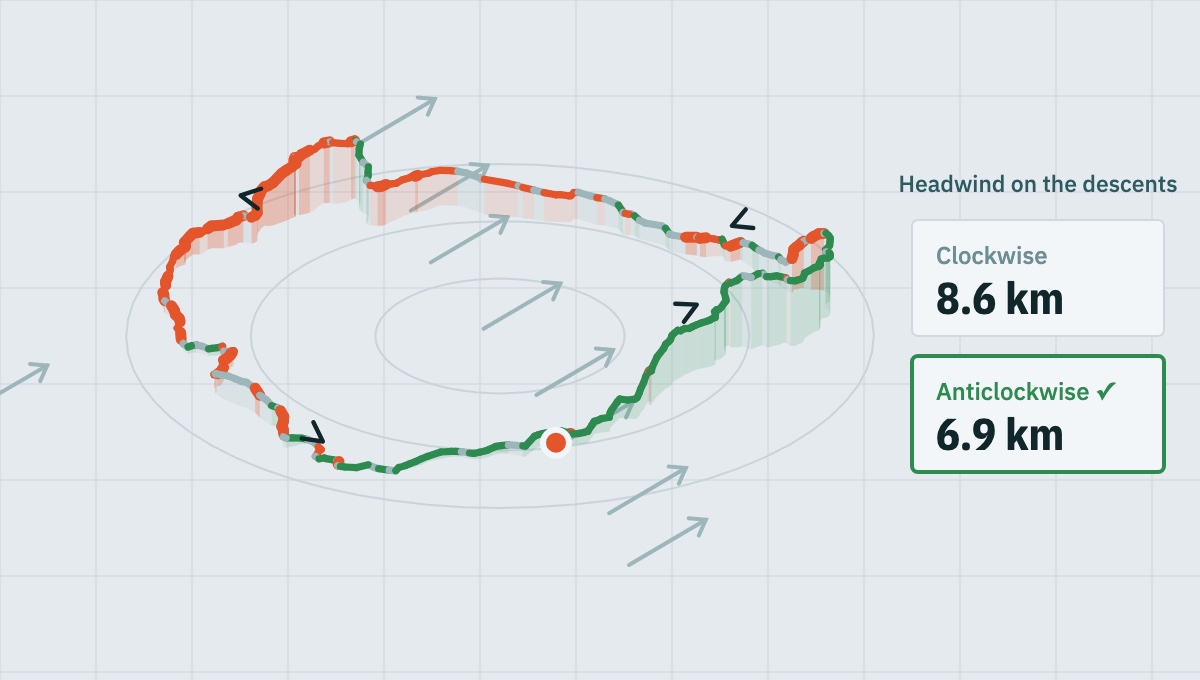
On a loop the same is true, but where you meet the wind can be chosen. Which way round to ride a loop
Into the wind and with it
| Wind | Into it | With it | 40 km out and back | Same work as |
|---|---|---|---|---|
| None | 26.5 km/h | 26.5 km/h | 1 h 31 min | — |
| 10 km/h | 20.9 km/h | 32.7 km/h | +3 min | 33 m of climbing |
| 20 km/h | 16.2 km/h | 39.5 km/h | +14 min | 137 m of climbing |
| 30 km/h | 12.4 km/h | 46.8 km/h | +32 min | 318 m of climbing |
| 40 km/h | 9.4 km/h | 50.0 km/h | +1 h 01 min | 605 m of climbing |
Speeds with the wind stop at 50 km/h, where the model assumes you stop pedalling. Same work as: the climb that would cost the same extra effort.
The same sum, in the app
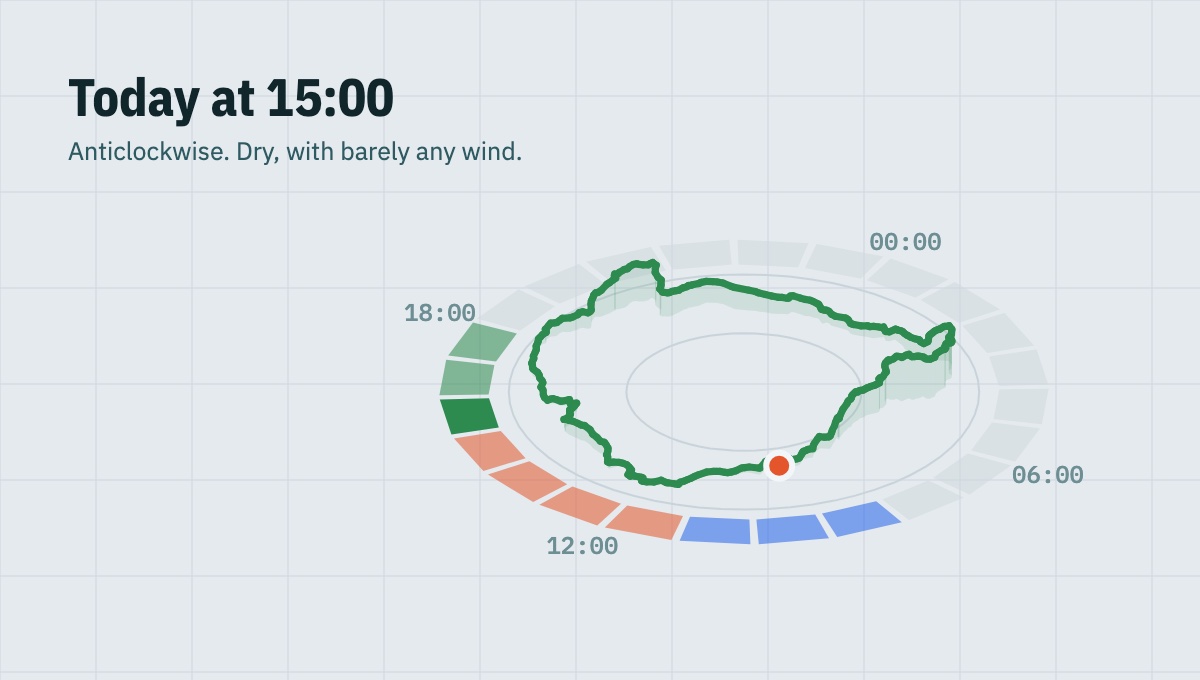
Linje works this out for every ride it builds, with the forecast wind on every stretch at the hour you would reach it. It shows the ride's real climb and, beside it, what the wind makes it feel like, in metres, for the hour you choose.
The model holds your effort steady and lets the speed fall, because that is what riders do: into a headwind you push about as hard as before and go slower.
How windy is too windy to cycle?
There is no single number. For the effort, the table above says what a wind costs, and whether that is too much is your call. For handling it is the gusts that matter, not the average: on an exposed road or a fast descent, look at the gust figure in the forecast.
| Force | Wind | What you see | Speed into it |
|---|---|---|---|
| 2, light breeze | 6–11 km/h | Wind felt on the face, leaves rustle | about 22 km/h |
| 3, gentle breeze | 12–19 km/h | Leaves and small twigs in constant motion | about 18 km/h |
| 4, moderate breeze | 20–28 km/h | Raises dust and loose paper, small branches move | about 15 km/h |
| 5, fresh breeze | 29–38 km/h | Small trees in leaf begin to sway | about 11 km/h |
| 6, strong breeze | 39–49 km/h | Large branches move, umbrellas hard to use | about 9 km/h |
| 7, near gale | 50–61 km/h | Whole trees move, hard to walk against | about 6 km/h |
Linje treats anything under about 3.5 m/s, 13 km/h, as calm: below that the wind is not a reason to pick one hour over another. The assumptions behind the model
Questions
How much does a headwind slow you down?
At a steady 150 watts, a rider doing 26.5 km/h in still air does about 21 km/h into a 10 km/h headwind, 16 km/h into 20 km/h and 12 km/h into 30 km/h.
Does a tailwind make up for a headwind?
No. You spend longer riding into the wind than with it, so wind always costs time overall. A 40 km out and back in a 20 km/h wind takes about 14 minutes longer than in calm air at 150 watts.
Is it better to start a ride into the wind?
On an out and back the total time is the same either way, and starting into the wind saves the tailwind for tired legs. On a loop, ride the way round that puts the least headwind on the descents.
How windy is too windy to cycle?
There is no single number. For effort, a 30 km/h headwind more than halves the speed of a 150 watt rider. For handling, watch the gusts: from force 6 on the Beaufort scale, 39 to 49 km/h, a gust on an exposed road or a fast descent can push a bike sideways.
Sources
- The Beaufort scale: Store norske leksikon
Figures worked out on with the model in the Linje app.
Related
Where are you riding next?
Linje builds the ride, then works out when to leave and which way round. Join the waitlist for early access.